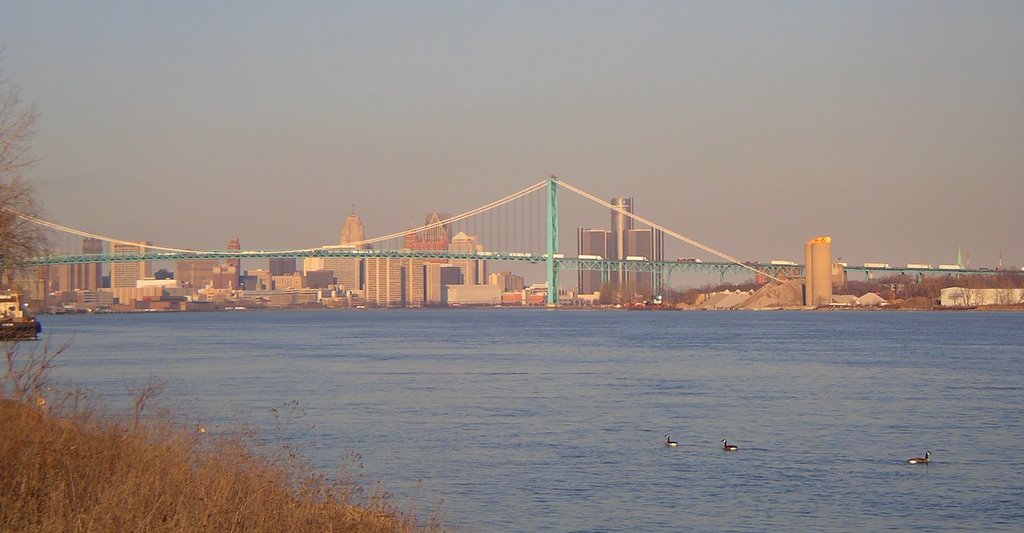
 With a week to go until the Big Day, the River Rant Committee on Major Event Preparation is proud to report that, by and large, the City of Detroit is looking better than it has in 30 years and is ready for the arrival of tens of thousands of football fans, the international press, and world-wide scrutiny. But only if your definition of Detroit is the limited to the downtown Central Business District ("CBD"). As soon you head one mile north, south, or west, it's as bad as ever.
 The Good
Never before have we seen the CBD looking so clean and fresh, with new businesses and restraurants and public facilities. The streets have been cleaned to where you could eat maple-walnut ice cream off the asphalt. The regular downtown derelicts who pester every pedestrian for a cigarette and a dollar have been rounded up and moved elsewhere (or displaced by the SB contruction projects). Long empty storefronts on Woodward Avenue have been boarded up and painted, or- even better, temporarily re-opened as Super Bowl XL apparel shops.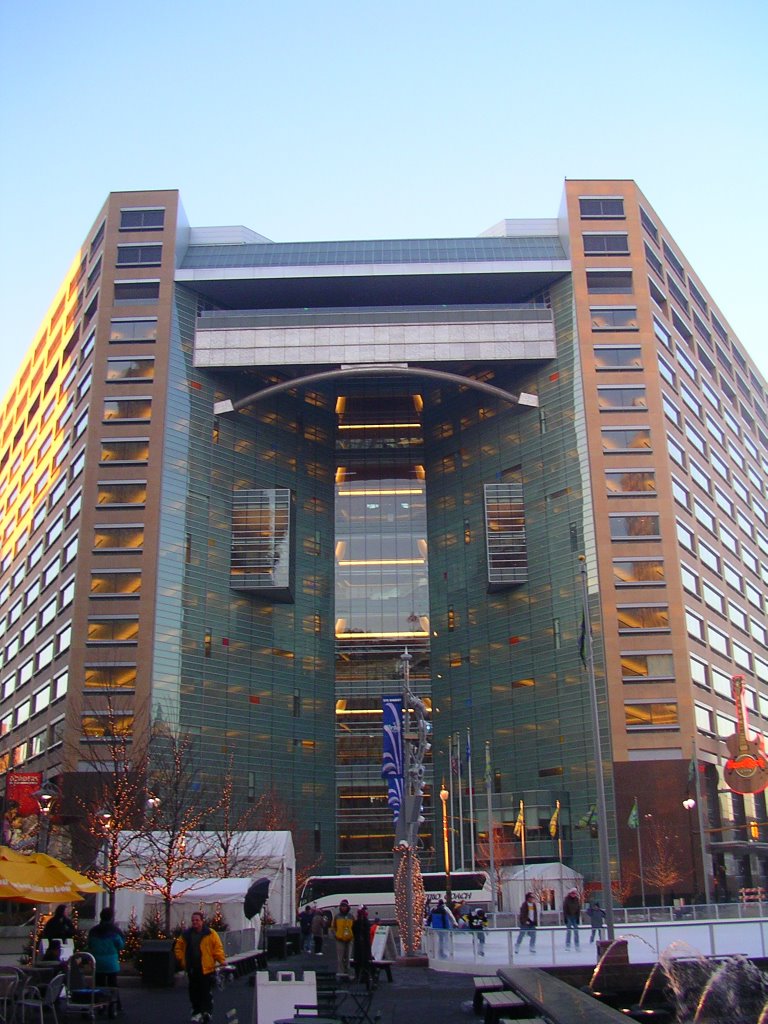 We have to give credit where credit is due, although making such deter-mination isn't crystal clear. Current Mayor Kwame Kilpatrick would like to take sole responsiblity for every improvement in the city (of course), but the fact is former Mayor Dennis Archer and several local philantropists (like Roger Penske and Mike Illitch) deserve equal, if not more credit. And a great deal of respect goes to companies like Compuserve, who invested millions into building their corporate headquarters in Detroit (pictured here on a rare clear Michigan winter day). Despite the improvements, this fact remains: investing entreprenurial capital in the city remains a risky and couragous endeavor. The endlessly-persistent obstacles of high taxes, an obscene crime rate, corrupt local politics, and inefficient municipal services make rebuilding this once-prized American city as daunting as setting up shop in Fallujah or Mosul.
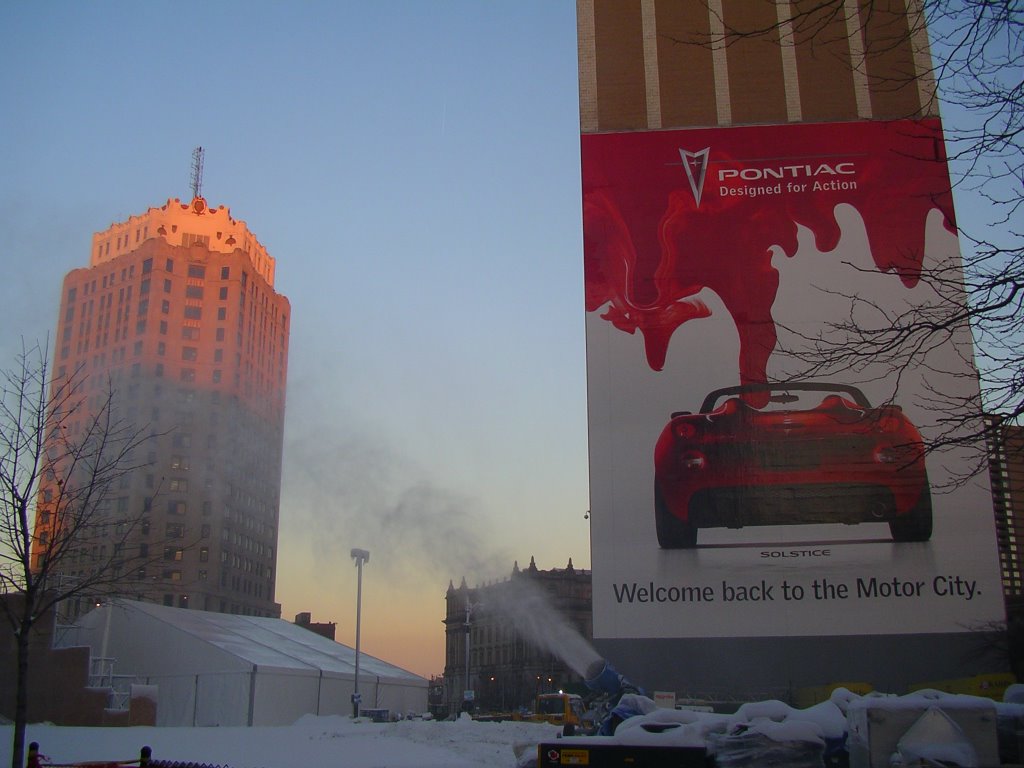 On Superbowl weekend 2006, as U.S. troops in Rumalah and Kabul and other bloody God-forsaken locales around the world watch the Big Game, Detroit will embody all that makes us American. As crews raised warming-tents and adorned the trees with Christmas lights, we witnessed sparks of kinetic energy and a spirit of renewal long absent in this challenged city. For a tranquil minute, as families skated in the January sun at Campus Martius and snow-machines blew fake snow for a sledding hill, as the waning half-light cast a warm orange glow on the skyscrapers, it felt like we were standing in one of America's most regal of cities...
The Bad
Then reality abruptly reared it's ugly head and shattered the bucolic moment, right in front of us and impossible to ignore (be patient, it takes a couple of minutes to download. Not like you're doing anything important right now. Hell, if you read RR, you obviously have more time than you know what to do with). He was a food service employee at the nearby Au Bon Pain coffee shop. She was an ex-girlfriend or wife or who knows. Security guards hustled her off the premises, and his boss came outside and yelled at him to "keep that shit away from here." An ephinany followed; the CBD ain't the real D. So we left and went searching for the grimy town we've known for the last three decades. And the Ugly
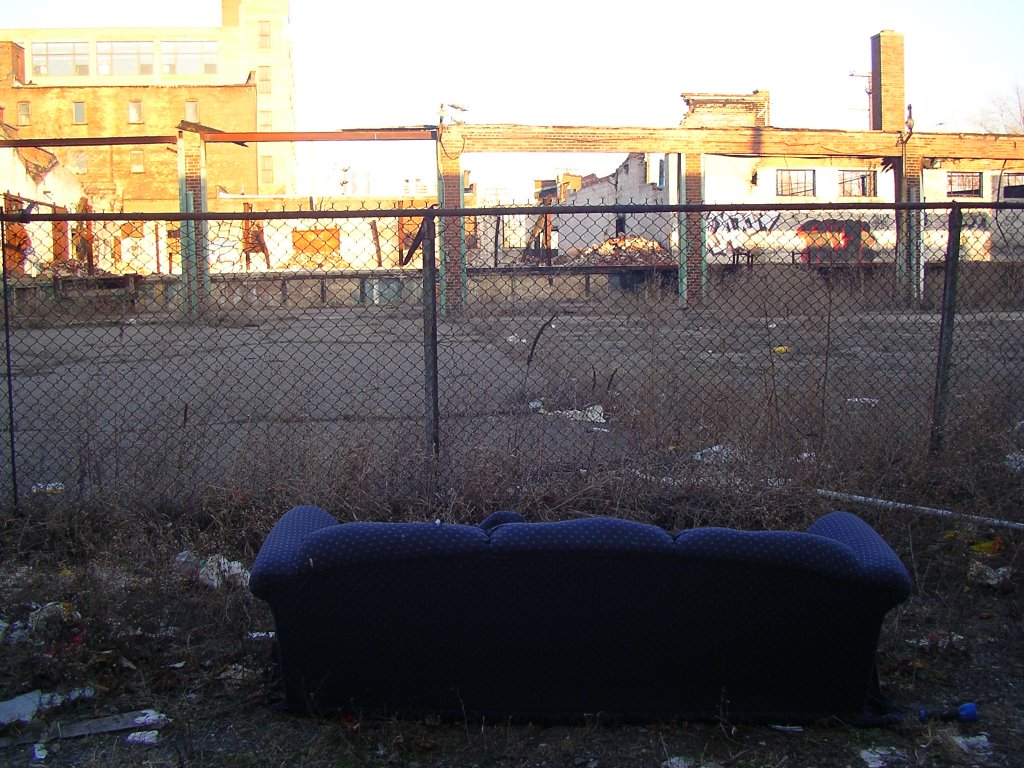
It took all of five minutes before we found true Detroit. Despite the downtown improvements, despite the new ballparks, despite the new cultural features, the city remains one of the most destitute, most crime ridden, most impoverished places in the developed world. Nowhere else (but Baghdad, perhaps) will you find more than 10,000 abandoned homes and businesses. The level of blight is impossible to describe. In neighborhoods like Del Ray and St. Aubin, it's not unusual to see entire city blocks where every home has been abandoned and all that remain are burned-out shells. The only inhabitants left are the addicts and the predators, the hustlers and the truly downtrodden.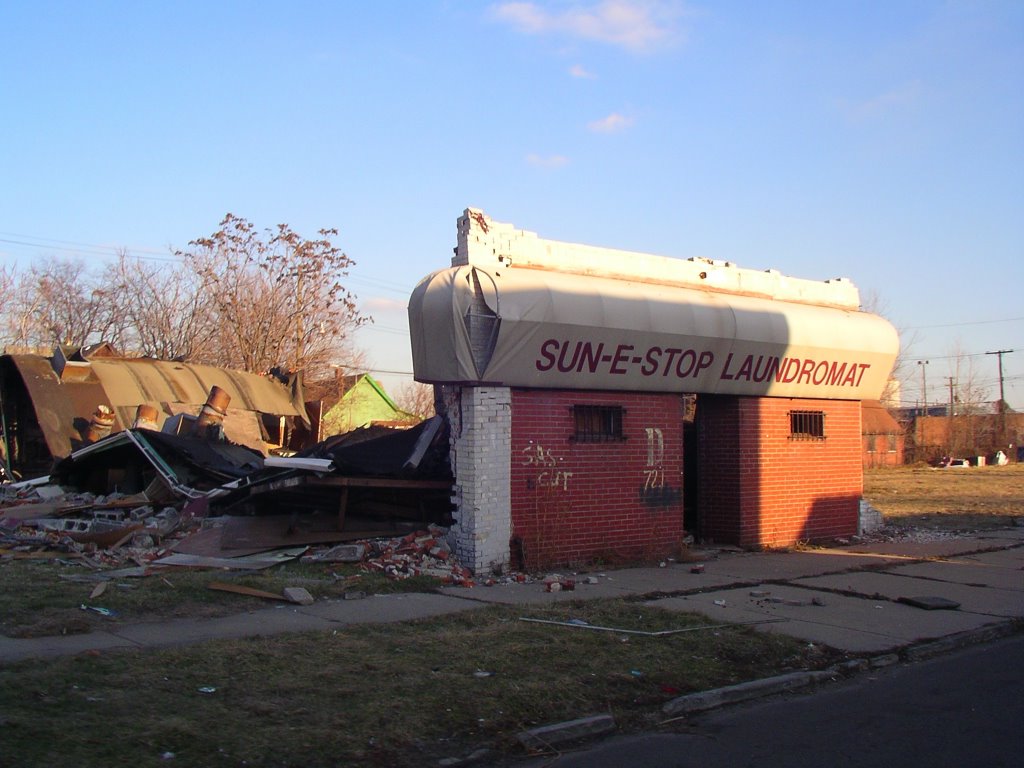 In some areas, it's as if the buildings have been stricken with some rare degenerative disease, the kind that causes a structure to implode on itself. This is a most unique Detroit phenomenon; why do so many buildings made of brick and steel collapse on their own volition? Vandalism can not bear total responsibility. And how does a canopy made of canvas outlast brick walls and a steel girder roof? So many questions in the D are not easily answerable.
 The old banks, with their thick walls of reinforced cement, are the only structures resistant to this plague. The roofs may collapse (through the windows at this branch you can see tree saplings fifteen feet tall shimmering in the slot-roof shards of sunlight), but the four sides will still be standing come Armageddon day. This must have been apparent to local clergymen as well, for when the banks closed they often became churches. Handpainted signs such as "The New Detroit Apostolic Temple of Holiness" or "The Greater Mt. Zion House of Praise" are posted underneath the old mason-cut "National Bank of Detroit" inlays. But in the end, even God's chosen ones recognized this was not the promised land of Canaan and departed.
 In the last forty years, nearly 1,000,000 residents have left the city. It's not just the neighborhoods that remain abandoned and forlorn. Numerous former auto-manufacturing businesses, once an intregral part of Detroit's golden age of industrial superiority, sit vacant. The future does not bode well. In the last week, Ford Motor Company announced a lay-off of 30,000 employees (nearly 1/3 of their workforce). Analysts are predicting a similiar down-sizing at General Motors. The only new automotive development in the state is a Toyota design facility, to be built an hour away from Detroit in pastoral Saline.
 Even the temporary buildings, brought in (we suspect) to facilitate the excavation of copper piping and scrap iron and whatever else of value, are left to the visagoths in the rush to leave the city. The vultures don't even give a shit. Sociologist James Q. Wilson refers to this breakdown of social mores as the "broken windows" theory; when delapidation and vandalism isn't stopped at the onset in distressed communities, it spreads like an agressive and malignant cancer.
 We hope SB XL goes off without a hitch. We hope the tens of thousands of people who come from around the world have a great time and enjoy themselves. We hope the millions of dollars generated from the event provides a much needed (albeit temporary) shot in the arm to the local economy. But we know, that come February 6, after everyone leaves and the Hollywood glitterati disappears, the D will still be the D, and except for the CBD, little will have changed.
1.27.2006
SB XL in the D: The Good, the Bad, and the Ugly

1.13.2006
The Kinsey Report
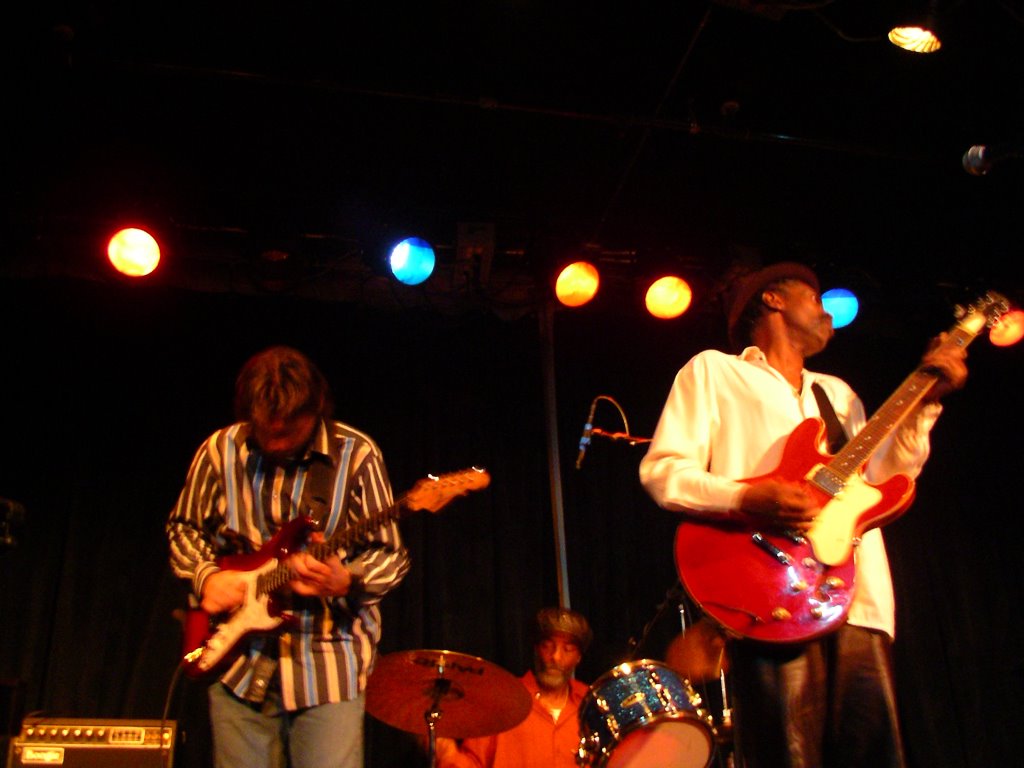 Sweet Jesus, we are coming home! The pagans may have celebrated Friday the 13th, January 2006 in their dark ways, but for River Rant, church was held at The Ark in Ann Arbor, where we stood witness to the holiest blues band in the country.
And we don't say this lightly. We've seen many of the living masters: Robert Cray, Sonny Seals, Buddy Guy, Matt "Guitar" Murphy, Lonnie Brooks, to name a few. Back in the college day, Rick's American Cafe in East Lansing would host the Chicago greats. Many a night was spent absorbing 10 cent Old Style drafts and bacon-grease slide guitar blues. But a sad transformation occurred: the bar changed management, and the new owners determined college students would fill the cash drawers regardless of who entertained them. So why pay internationally recognized musicians when you can make more money by hiring a college student DJ to spin Moby cd's? It was a damn shame.
The Kinsey Report is the varsity squad of shot n' a beer and broken guitar string blues. Raised by Mississippi blues purest "Big Daddy" Lester Kinsey, sons' Donald, Kenny, and Ralph grew up playing in their father's band. Oldest son Donald broke from the family in the 1970's and became Bob Marley's guitarist. The prodigal son returned to the fold in the early '80's and added a reggae funkgrove to their sound.
After going to Kinsey Report shows for years in East Lansing, the last time we saw them was in Jackson Hole, Wyoming in 1992 at the Mangy Moose . Then everything fell apart. We moved to the back corner of nowhere for 10 years and lived under a cow pie. Big Daddy died in 1995, right when the genre began to fade in popularity. The band quit recording and for a while, stopped touring. They're back, and sound better than ever. New member White Lightning is a blues guitar virtuoso. His dirty riffs crack thick and deep and come from a forboding place- like a certain Mississippi delta crossroads where Robert Johnson sold his soul to the devil. He's got the mojo hand, and must've paid a hell of a price to get it.
Here's a juicy piece of old school rockin' blues, served raw with a whiskey shot.
11.17.2005
Deer Season
 Fire up the grill and get the back-straps marinating! It's deer season in Michigan, time to harvest the abundant bounty we are over-blessed with.
Lower Michigan counties have among the nations' highest rates of deer-vehicle collisions. In 2003, there were some 60,000 such accidents, 11 of which ended in people dying. I've had two head-on collisions over the years, and there have been numerous other close calls. With nearly two million of these big critters roaming the Michigan countryside, there's no shortage of deer habitating the local terra firma. Open the hunting season earlier. Close it later. Allow for more doe tags. Thin the herd. In counties where the population exceeds the carrying capacity, collisions with cars, disease, and winter starvation results in greater deer mortalities than from hunting. A 125 grain bullet is a much quicker and humane way to die than being crippled by a car and crawling into the bushes to slowly bleed to death. And, unlike the road-kill carcasses which sit bloody for all to see on the side of the road for days stinking with their guts strewn about, a hunter-kill is made into delicious venison lasagna and jalapeno salami. Hunting is part of the circle of life our species has depended on since the dawn of time.
 For years, the Ann Arbor PETA chapter would show up at the town deer pole and yell and holler and make a big scene. Fathers who stood proud when their kid bagged their first buck are called barbaric killers. Locals are antagonized and no one's mind is changed in the least. TV news crews film the staged drama and the snippet at six showed a guy with silly hand puppets talking about how Sigmund the Squirrel misses his best friend, Beauregard the Buck.
Then PETA stopped coming. It's been awhile since the PETA circus rolled into town. The Riverrant Committee on Cervid Activism is at a loss for the exact reason why, but posits one possible cause: perhaps there was a change in perspective when the chapter president ran head-on into a 200 pound buck while driving at 70 mph on I-94 at night and had to deal with a crumpled car, insurance deductibles, a righteous case of whiplash, and a most unholy mess in their drawers.
That's possible, but not the likely reason. They're probably too busy protesting the war in front of the near-empty Ann Arbor federal building or boycotting Wal-Mart or going to Buddhism class or making Kabalah bracelets. In the meantime, we'll be doing Mother Nature and the motoring public a favor and enjoying a hot pan of garlic venison mosticolli.
11.01.2005
WestWorld
 A recent study conducted by the American Psychiatric Association determined the best form of mental health pre-ventative medicine is a road trip to the middle of nowhere. The study found that people who intentionally took aimless wanderings to places with names like "Truth or Consequences" or "Redemption" or "Wisdom" (all real towns in the middle of BFE America), are less likely to use psychotrophic medication and need long-term psychotherapy.
Like there was such a study and like I really know jackshit about preventative mental health. If you really feel like jumping off a bridge, by all means, get some professional help. But, if you're feeling a little down about your lot in life and talking to Dr. Giggles about your most personal and private thoughts makes you a little sheepish... then Go West Young Man!
I've had a love affair with the American west since I was 21. I blew off college graduation to hit the blue highways and have returned often. The mix of scenery, history, adventure, and sense of freedom has made for one powerful and enchanting spell, an especially strong hex on those of us whose daily existence often involves combat traffic, rude people, work deadlines, and factory smokestacks on the near horizon. Nothing clears the head of the useless clutter and debris strewn about by the cyclic loading of modern life like a desert sunset.
 Roadside memorials glimmer with candles that are always lit. Pictures and memorials tell of young soldiers lost in battle and of the old ones who lived long and fruitful lives. In the upper midwest, you die and are buried and forgotten. The only roadside memorials are the white crosses hammered onto the telephone poles where some poor driver creened into it. If I were to be killed in such an accident, the last place I'd want to be remembered is the pole or tree I ran into.
Everywhere you go there's something cool to look at and learn about. Old pony express stations, abandoned mining towns, preserved cliff dwellings, historical battle sites, and gravesites of famous Indian warriors dot the barren landscape. Critters appear and make known to the casual wanderer that this is their home and you are but a visitor here, tolerated as long as you give due respect.

9.28.2005
Three swims on the Middle Fork
 Please accept our most sincere apologies from all of us at Riverrant. Our mission statement proclaims this blog will center on rivers and all things collateral, but instead we've been warbling on about toothaches and politics. We hope you aren't too disappointed with the digressions.
But hopefully this posting will bring us back to our raison d'etre, although summer is rapidly disappearing and it may be months before another river expedition is chronicled. Once a year, there has to be a serious river trip. We're not talking two inner tubes and a cooler. It must involve cooking over open firex, big oar rafts, and pooping in a bucket. Other basic requirements include it's somewhere out west or in Canada and lasts (at least) a week.
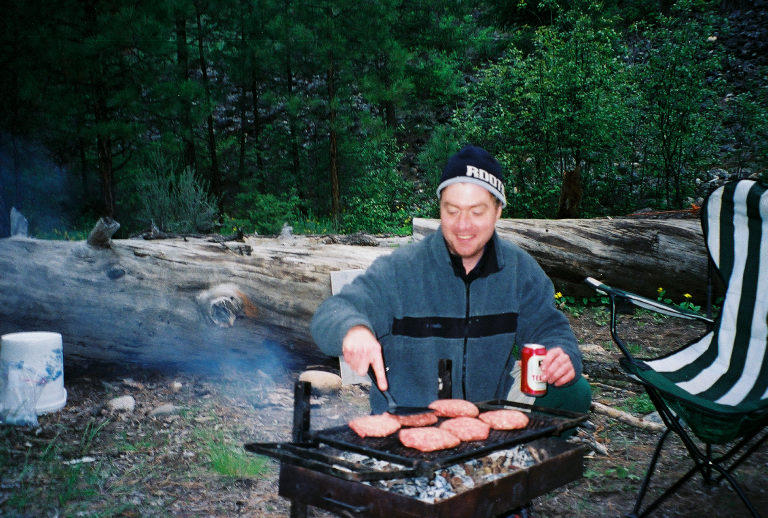 Even when the weather is bad, even when you get covered in poison ivy, even when the toilet paper gets wet on the first day, these trips rule. They are the perfect mix of high adventure, incredible scenery, interesting geology, friendship, beer, and killer meals. As long as I am ambulatory, I'll be running these rivers.
So the big trip of 2005 was the Middle Fork of the Salmon River in central Idaho. The Owyhee, the Main Fork of the Salmon, the John Day, the Petawawa, and the Snake are among the other favorites, but this year we ran one of the most spectacular, most revered, and most challenging long runs in North America.
Originating from the high peaks of the Sawtooth Mountains, the Middle Fork of the Salmon River flows some 100 miles before joining the Main Fork. After the launch at Boundary Creek, no roads access until the take-out. The river bisects the two million acre Frank Church Wilderness of No Return, the largest roadless area in the lower 48. Bald eagles soar high over batholith-era granite cliffs. Shoshone Indian petroglyphs and their traditional summer campsites dot the river corridor. Hot springs bubble up from pre-historic volcanic vents. Over 100 rapids provide ample challenge for journeyman boaters. Other than a handful of old mining cabins or century-old hard scrabble ranches, there is minimal sign of modern man.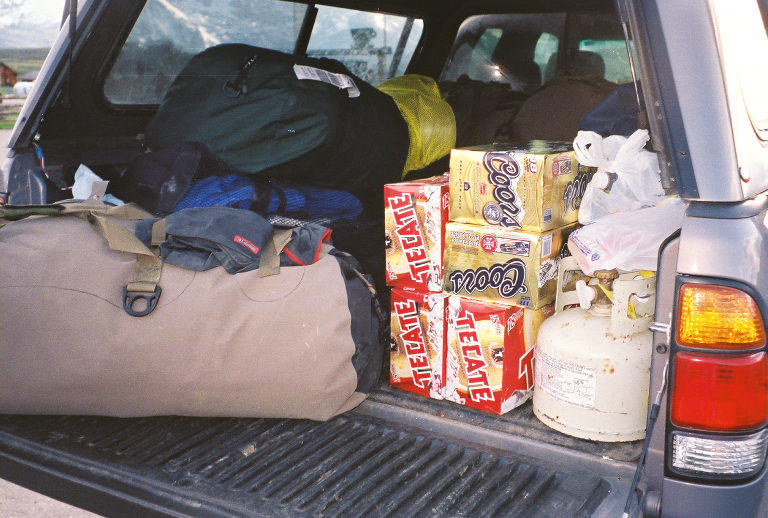 The journey to the launch had signs of bad luck, which is never a good thing. First of all, my bags were lost by Northwest Airlines (but do show up the next day). Then, on the drive up from Boise, we pass a serious motorcycle accident on a tight mountain curve. Two Harleys, riding parallel, bumped into each other, sending one rider into the rock wall and the other into the guardrail. Idaho State Troopers hover over crumpled bikes and blood stains on the asphalt. Leather jackets and cracked helmets lie in the road. I'm not a strong believer in bad karma, but witnessing a gruesome scene does create reason for pause.
Then, when we pulled into Stanley, Idaho, we met a group of rafters who launched at Marsh Creek, a small tributary used when the access road to Boundary Creek is snowed in. Their gear was strewn across the motel parking lot. Their story was most unfortunate: Marsh Creek showed no love. Rafts broached on logs and punctured. People were injured and gear and group dynamics deteriorated into a classic "Lord of the Flies" battle of personalities. Ironically, their bad luck is to our advantage: they paid to have a snowcat plow the way into Boundary Creek so they could be extracated. Which allowed us to be the first party of the year to launch from the traditional Middle Fork starting point. With flows at 3.5 feet (moderately high) on the staff gage, we launched. I had my old 11' foot Achilles tub boat (a dinosaur from a bygone era that pre-dates modern day self-bailers and catarafts) that I bought ten years ago from an outfitter in Bend, Oregon who was getting rid of his old boats. As I stood there looking at the fast churning water, I knew things were going to get interesting. This river is no place for dumbshits using out-dated and undersized gear.
The stretch to Scout Camp was technical, but lines were easy to find. My small boat handled the maneuvers around Velvet Falls and through Powerhouse Rapids quite well. Then it began to rain. And the rain brought down the remaining snow melt from the high peaks,
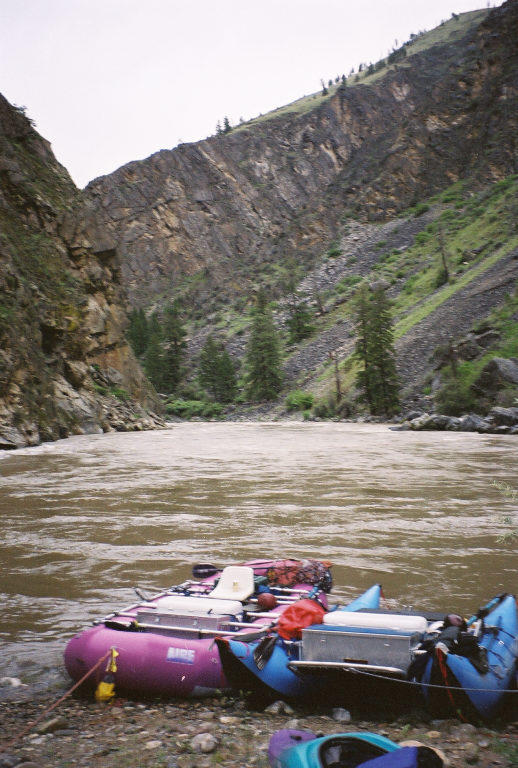
We hunkered down for a day, waiting for better weather. The river rose to 6.5 feet on the gage, which may mean nothing to you, but at this level the U.S. Forest Service and many commercial outfitters suspend their operations as this traditional pool and drop river becomes one continous Class IV torrent of water.
A large pillow wave at Pistol Creek rapid tossed me from the boat and I flushed into a large hole. Not my first swim ever, but with water temps in the thirties, my chest tightened as my heart pumped blood to my extremities. I recovered quickly, albeit chilled and with renewed respect for the situation I'm in.
Water levels continued to peak and the heavy run-off from side canyons added muddy water and tree trunks. Eddies disappeared and huge wave trains led from one rapid into the next. Amazingly, I completed another sixty miles without incident, sneaking around big rapids and avoiding bellowing holes. Until Weber Rapids.
I hit a massive diagonal wave and flipped like a western omelet. The bow of my raft lurched into the air and landed on top of me. Dark icy water enveloped me as I spun and tumbled through violent hydrolics. I was trapped under my raft for a brief moment that seemed like eternity before I managed to push away and re-surface. The river propelled me and my over-turned raft downstream several hundred yards before another raft collected us in an eddy.
The long cold swim left my muscles fatigued and my mind fogged. Back at the helm of my raft, I could feel the power ebbing from my oar strokes. Within minutes, I hit a huge wave train below Ship Island Camp and flipped again. I swam to the shore, and watched helplessly as the rafts and kayaks in my group got swept downstream in the fast current. One of the rafts found an eddy 200 yards downstream, and Tony yelled at me to jump in and swim towards them. I jumped, only to get spun backwards into an upstream eddy and face-plant into the backside of a boulder. A gnarly circulating whirpool pressed me hard against the rock as water flowed over my head. I thought to myself, "This is how you drown." My lizard brain kicked in and I somehow I push off and swam to shore. A moment of pause occurs to process the magnitude of the situation.
I forced myself to run and jump from a small cliff ledge into the main flow of the current- not an easy step after just breaking free from a partially submerged rockpin. I swam hard towards the raft and yelled for a rescue rope. Tony and Big Jim tossed it and pulled me in. Whew. I'm safe, but cold. Real cold. We mase it another couple of miles to Cradle Creek camp to where my boat and gear are recovered. A very hospitable and generous party we launched with had warm tea and beef stroganoff on the stove. Angels sent by the Big Rafter in the sky! My clothes got stripped off and I slowly began to warm in front of the fire, fully aware my next trip could have been down the River Hades.
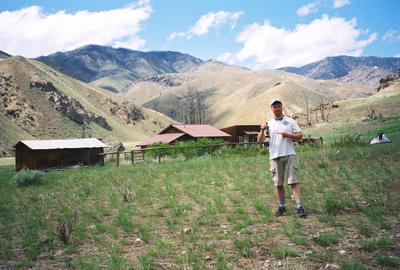 On the last day, the skies broke indigo blue and we came out one big happy party. My boat was deflated and packed up for the last ten miles- better not push my luck. The little Achilles made it ninety miles on a swollen mountain river during high flow. That's worth celebrating with a Deschutes Porter. It was a great trip. Good company, spectacular scenery, great hot springs, and more adventure than I could ask for. All limbs intact and no gear lost. But next time, I'll be in a 14' self-bailing Maravia.
Mike, Tony, Jim, Emily, Iayana, Cat, Rick, and the two doctors: Thanks for a great trip and saving my bacon. SYOTR.
Editors note: in the years since this trip, both Tony and Rick have passed away. After decades of boating, this was their last trip.
9.06.2005
Up North
 I usually avoid joining the mass exodus from southeastern Michigan that heads "Up North" on holiday weekends, but an invitation to stay at a friend's summer getaway was too good to pass up. Get out the cut-off shorts and tacky shirts- it's time to become a fudge-buying, poor-tipping, highway-clogging Tourist!
After living in five states and traversing through another thirty over the years, I can confidently say northern Michigan is as beautiful as any place in North America. Opal blue waters gently tickle the pebbled beaches. Virgin beech forests cover wooded knolls. Panoramic views fill the wide-open expanse on every horizon. It's a world where people are friendly by choice and missing from the local headlines are stories of murder, freeway wrecks, and urban decline. Over breakfast at the nearby mom and pop kettle, the locals talk about cutting firewood before the weather turns and recent sign of buck rubs on the maple saplings. Seasonal tourons like myself are loved and hated in the same breath for our economic benefits and lack of manners and decorum.
 With the help of a MegaMillions jackpot, I'll be giving up my evil tourist ways and joining the choir at the Church of Our Lady of the Lakefront Rich and Wealthy. I'm not a materialistic guy, but if ever get a few nickels in my pocket, I'll add this sunset-view hacienda to my other homes in Sedona and Jackson Hole. The guy who occasionally stays at this little "cottage" owns a chain of tire stores. Every time you buy a new set of treads for your hooptee, you help pay his winter heating bill.
 But until the day my lucky numbers hit, I'll have to be satis-fied with million dollar views from the nearby public access instead. The wait will be worth it. And when I hit the big one, y'all will be on the invite list for the biggest party ever held on the Lake Michigan shore.


