Baseline Lake in Livingston County was a scene most tranquil this past weekend (as you can attest to from looking at this serene photo. Breath deeply and think of pleasant summer nights and warm cider wine. Try to forget about that rash problem. Turn up the new Enya cd a couple of decibels. Light another stick of pachouli incense and dream of warm-oil massages. That's what RR is doing right now). Over in Hell, though, after last weeks "666" party, things aren't so blissful. In fact, all heck is breaking lose....
After we left the shindig, things spiraled downward, as reported in this newspaper article:
Disorderly behavior, parking complaints and crowd-control problems mounted in Hell Tuesday as John Colone's much-publicized "666 Party" continued into the night, and when Colone — the Putnam Township hamlet's unofficial mayor — found himself at the wrong end of a punch from a disorderly reveler.
"It was no big deal. I have a cut on my nose, and it feels a little worse," Colone said after staying until 2:30 a.m. Wednesday cleaning up. "It was over in seconds, and we left on good terms."
Livingston County Sheriff Bob Bezotte said problems began to increase as the festivities and devilish fun wore down late Tuesday evening. Bezotte sent five extra deputies to Hell as the party intensified along with complaints from area residents. He said he heard about 8,000 people attended Tuesday's party, but Colone said there were closer to 12,000 visitors.
The police arrested someone for throwing a beer can at a police lieutenant near the Dam Site Inn. The department is seeking felonious assault charges against the person through Prosecutor David Morse's office. Police also arrested a Midland man for disorderly conduct after he pushed two people on the porch of Screams Ice Cream, and for assaulting another person as he ran away.
The man, who was believed to be intoxicated, later attempted to strike police troopers, and was lodged in the Livingston County jail for the night.
In a related situation, a man driving an all-terrain vehicle reportedly crashed his ATV around midnight near Weiman Drive, south of Patterson Lake Road. Further details were unknown Wednesday.
Colone said there were a couple of thefts Tuesday, including a slab of children's cemented footprints and a witch's head from that was mounted on a cooler.
Crazy shit for town of 75 people, eh? The "mayor" got popped in the nose. Traffic came to a complete stop. Cops hauled drunken idiots off to jail. An ATV flipped over. 8,000 or 12,000 or noonereallyknowshowmany people jammed into a quiet midwestern village with 75 year-round residents. Frankly, we're surprised it wasn't worse, much worse, when we look back on the day. The crowd, a bizarre mixture of bikers and weirdos, well-intentioned preachers and misguided hellions, was amped to 11 on the civil disturbance dial thanks to summer temperatures and heated arguments over the wages of sin and the cost of another beer. We're surprised Hell didn't go up in flames.
And you know the three businesses that make up the Hell Chamber of Commerce (the Hell General Store, Scream's Ice Cream, and the Damsite Inn), made a killing on 666. We predict they will celebrate June 6 every year from now on. And next year, the hype and hoopla will warrant replacing Dead Elvis with Alice Cooper.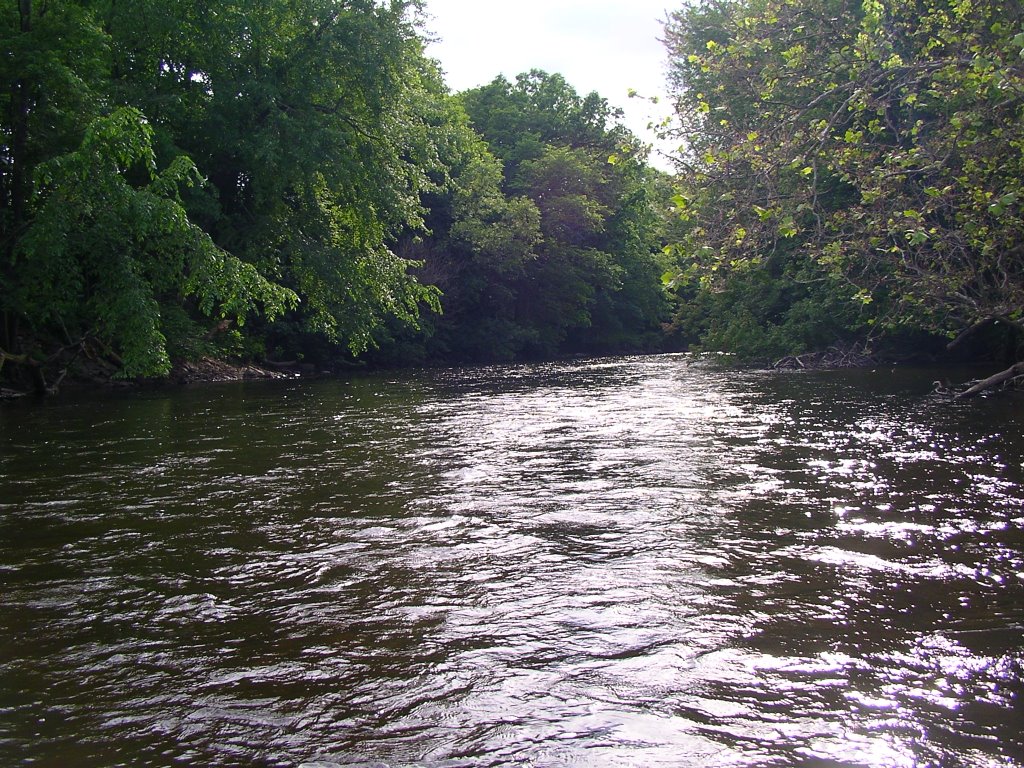 Once was enough for us. Next 06/06, we'll instead hit the river, like we did on Sunday. It was a perfect day for our fourth trip down the Huron this year. We could canoe this river every day. Everytime, we see something new. Here's another little river vignette, courtesy of RR adventure films. Some people make home movies of birthday parties or their cat playing with a ball of yarn. Not us.
We'll leave you with another moment on the Huron. Enjoy. We sure do.
6.12.2006
Back from Hell

6.10.2006
Halloween in June
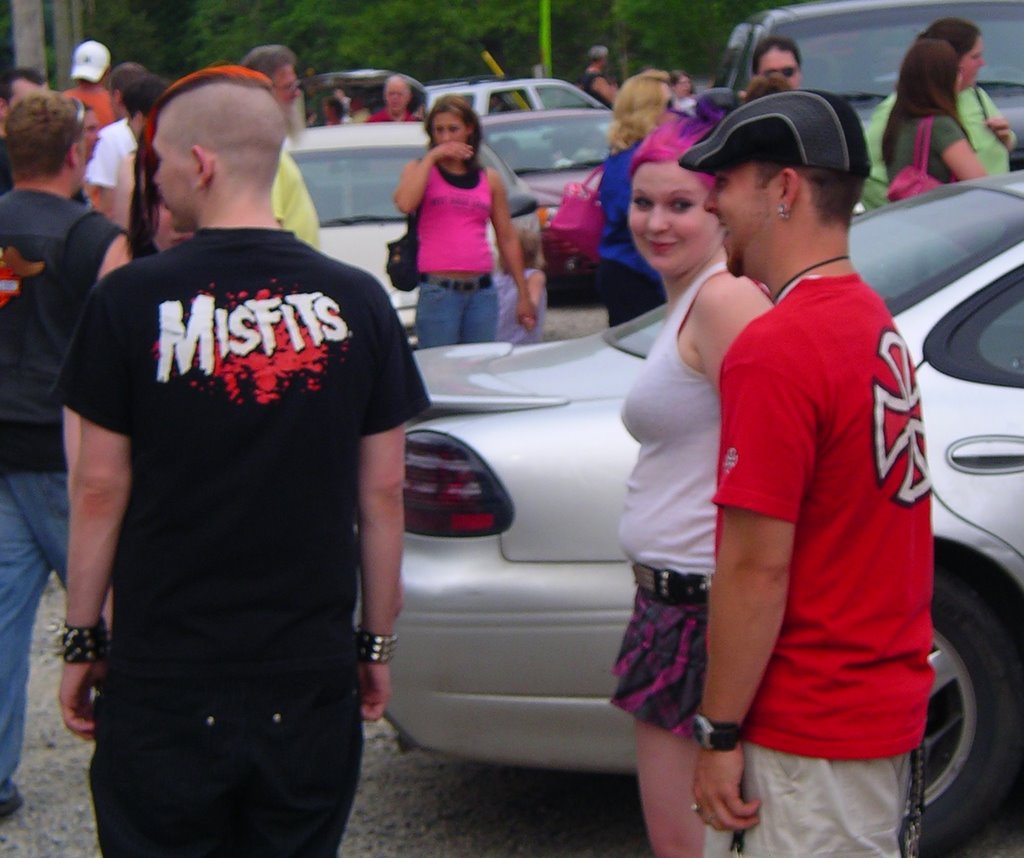
 We don't celebrate Halloween in June but every hundred years, and after witnessing "666" this week in Hell (Michigan), we're going to squeeze more blood from the turnip and conjure up another post. It was a macabre mix of fake dimestore blood and real (who knows?) skull and bones dug up from who knows where. Some of the folks that showed up were dressed like ghouls and ghosts for the simple festive fun of it. Other folks, who looked like week-old road kill, probably dress that way all the time. It was easy to differentiate the two groups: one smelled of beer and brats from the food tent and the other smelled of rotten possum and dead reptiles.
 Over by the old hearse collection, a skeleton in a body bag was parked on the grass. It'd be easy to assume it wasn't real (we couldn't tell), but for the fact that human skeletons are so remarkably easy to get. Numerous sites (including ebay) legally sell old skulls and skeletons (this $1000 fetal skull is rather unsettling. Whoever would buy such an item is one sick pup. But those people are out there. Some people collect Beanie Babies and duck decoys. Other people collect deformed brain carriages. It's a strange world we live in). If Mr. Bones here was fake, they did a damn good job making him look real. If this was real, somewhere out there is an empty grave.
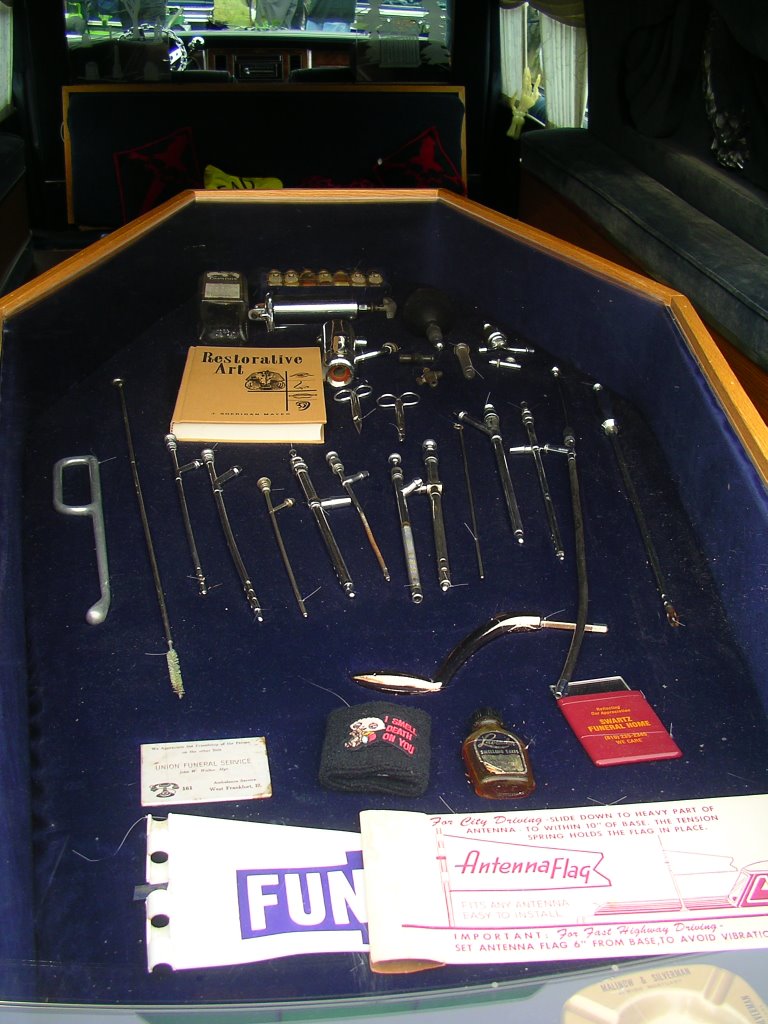 Also bizarre and noteworthy was this collection of embalmer tools. Anyone who would collect an assortment of tools used to pull out yer innards is a little off. Not as much as the whack who collects fetus skulls, but still a little off. What's wrong with collecting baseball cards and old fishing lures? Or old Playboys and license plates? We've never understood the obsessive nature of the hard-core collectors. We once knew a 6'6", 350 pound tattoo artist in Ohio who collected gumball machines, skulls (he had hundreds of skulls ranging from field mice to hippos), and the artwork of serial killers. He had several originals from the likes of John Wayne Gacy and Henry Lee Lucas. Collecting wierd shit was his mission in life. Apparently, writing about it is ours.
 On a lighter note, behind the ice scream shop, Dead Elvis was belting out his tired collection of Halloween songs. Ugh. How many times must we suffer through "The Monster Mash" and "The Addams Family Theme"? When he did a rap version of "Hootie the Boo Owl", we threw up in our mouth a little. He had an audience of maybe three people at any given moment.
 Needless to say, the kids weren't exactly digging his act. They were amused by it, but with the kind of funny-pity amusement you get while watching a doofus embarass himself in public. The kind normally reserved for, hmmm, karaoke night at the local bowling alley. You're laughing, but not because the song's funny.
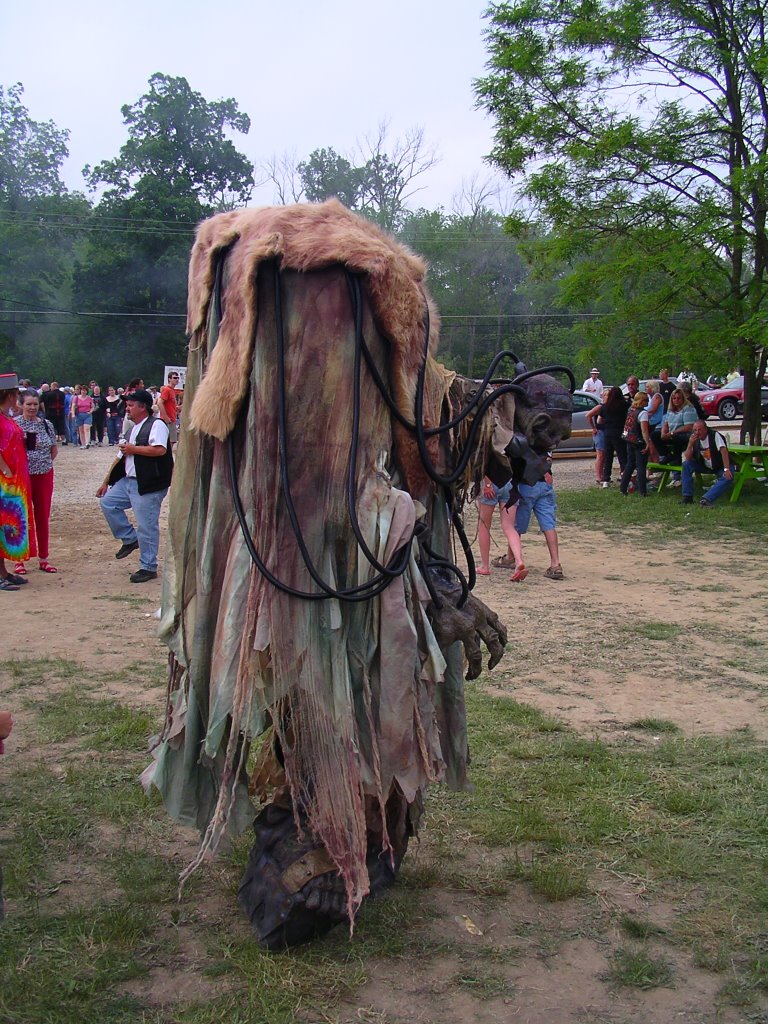 The best costume award had to go this thing, whatever the hell it is. And with temps in the high 80's, no doubt it was hotter than hell under all that rubber and fur. That alone deserved a prize.
5.19.2006
The Canyon Grande
 One place we've been meaning to visit for several years is the Grand Canyon. We'd make plans, then something unexpected would come up: a paternity hearing. Bankruptcy court. Electroshock therapy. Reverse vascetomy. Life always found a way to interfere with the most well-intentioned of plans. Last week, we finally were able to stand at the south rim, and for the first time, look down into the biggest hole on earth. Like the Louvre in France or the I-94 tire in Allen Park, the Grand Canyon is one of those places everyone should see at some point in their life. Mash your greasy finger here and witness the RR panoramic view, filmed in full technicolor.
 Viewing the layers of strata takes us down into the basement of time, when the earth was in primordial infancy. While the canyon is estimated at being 6 million years old (a geological blink of the eye), the strains of Zoroaster granite at the edge of the Colorado River date back 1.8 billion years. Like the rings in a crosscut section of a tree, the layers of shist, shale, and sandstone correlate to notable eras in the history of the universe: when Shinumo Quartzite (1.2 billion years ago) was the crust, your great-grandparents were miserable little flukes floating in a murky inland ocean. When the Temple Butte Dolamite (360 million years ago) was the top layer, your kinfolk were slimy snakeheads with jointless legs that ate little bugs and slithered around in their own excrement. The existing top layer of Kaibab Limestone has been there some 245 million years. Your ancestors were just beginning to grow fuzz on their nape back then. It was sometime around 5 million years ago the Colorado River began to carve into the Kaibab plateau, about the same time your grandpappy became a bipedal primate, swinging on jungle vines and beginning to walk upright.
 One giant mis-perception is the canyon was created by years of gentle pitter-patter rain and grain-by-grain erosion. Not true. The process, like many in the natural world, was violent and brutal. Pacific ocean winds, warm and moist like a bran muffin from Tim Hortons, release their wet load when they collide into high cold air from above the plateau. The storms are short but powerful: the rain falls hard and fast and hits the soft sandstone and shale with bullet-like velocity. Side canyons and small arroyos flood with sudden immediacy. A fast-moving slurry of water, mud, and rock explodes downward and further deepens the canyon before dumping into the Colorado River.
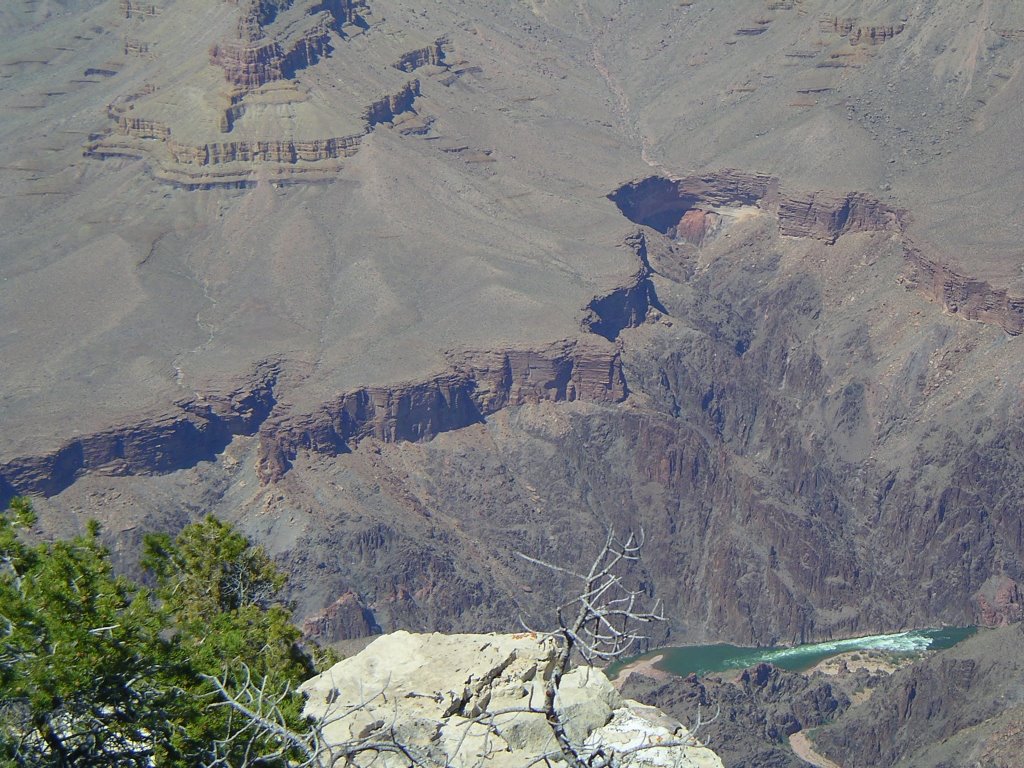 Looky here. See that ribbon of green and white in the lower right corner of the pic? That's one of the major rapids on the Colorado River, as seen from a mile (or thereabouts) above. That's the closest we'll get to western whitewater this year. Sucks, too. Could be worse though, especially after last year's ride down the Middle Fork of the Salmon in Idaho, where we almost became a permanent resident of the river. We made it out alive (obviously), but three flips and three long gnarly swims on a swollen mountain river is too close to the edge. Speaking of close to the edge, there is a fascinating book about the 600 people who have died in the last 100 hundred years at the Grand Canyon. Over the Edge: Death in the Grand Canyon maticulously chronicles every fatality; some were leathered old prospectors who fell into mine pits. Many were ill-prepared hikers who succumbed to heat stroke or dehydration or had a heart attack on the hike back up. Other deaths were more bizarre: like the guy who was trying to impress his friends by jumping from rock outcrop to rock outcrop but slipped and and fell 400 feet to his death, as his buddy had the camcorder going. Or the dude who was taking a photograph of the El Tovar Hotel and keep backing up and backing up until... Ooops! BAH BYE! Or the hikers who figured they'd take a short cut up a sandy-bottom side canyon, unaware a thunderstorm had earlier dumped an inch of rain up top, and suddenly they're riding down a death-slide on roiling, boulder-chocked torrent towards the Colorado River. Or the many suicides: the Grand Canyon must be second only to the San Francisco Bridge in this regard. Every year, people walk to the rim edge, give white-eyed onlookers their suicide note, and then take 600 foot Nestle Tea plunges into the abyss. And, so far, ten people have done a "Thelma & Louise" (named after the final scene in the movie where the two despondant women drive their car over the cliff into the canyon). No shit- people actually do this in real life. According to the book, one driver ran atop some rocks on the very edge of the rim and high-centered his car, stopping all forward motion. So he hopped out of the car, smiled and waved at the shocked bystanders, and jumped anyway.
 Further down the rim trail, we stumbled across the Orphan Mine. Running into old mines in national parks is rather unusual, especially in parks as well known as the Grand Canyon. Hmmm. Let's look into this a bit: the mine was patented in 1906 after hardscrabble prospectors found some copper deposits. For years, the operation was one of the thousands of small scale mining operations that dotted the western landscape. Until 1951, when geologists found one of the largest known uranium deposits in North America at the site. Uranium, huh? Well, we're kinda in an arms race with the USSR right now. Guess we'll dig the shit up. No reason to let it sit in the dirt. We need more bombs. Fifty-five years later, the site is a debris-strewn eyesore with radioactive waste that will be there 500,000 years from now.
 So, we'd advise you bring bottled water if you visit the Grand Canyon, unless you worry not about your bell-end glowing like ET's finger after drinking radioisotopic water. And you might want to avoid the many tourist traps on Highway 64. Unless you're into "authentic Indian crafts" made in the Republic of China.
Go see the Big Hole. Someday.
5.15.2006
Only in Vegas
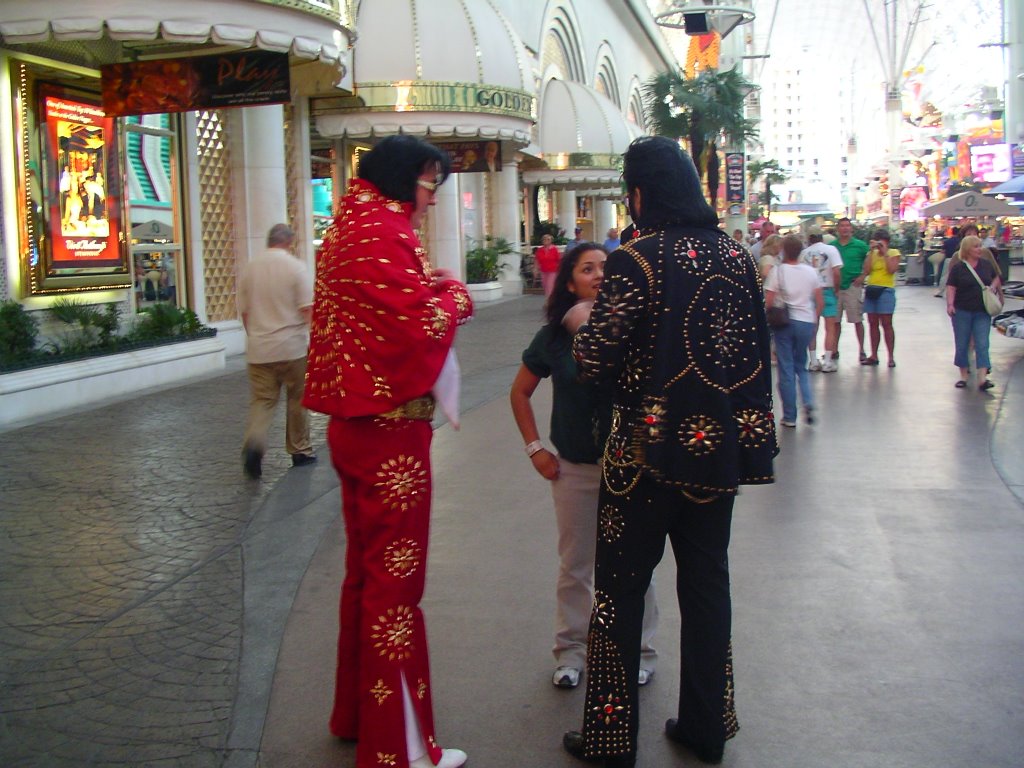 2,000,000 years from now, long after the sun has imploded and our planet has turned into a lifeless ball of ice, spacemen in little silver orbs will land on Earth on an intergalatic reconaissance mission. We hope they land in Las Vegas, for this reason: no where else in the Universe will they find a place that represents the duality of mankind in such well-defined and transparent terms.
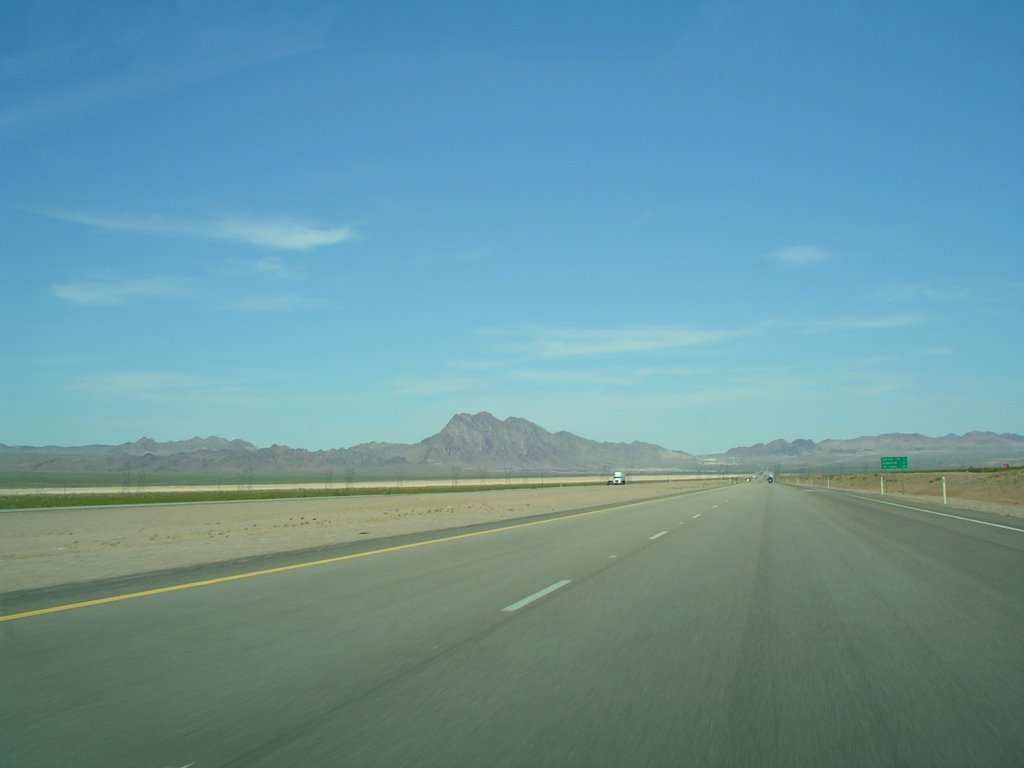 Getting to Vegas from Laughlin meant a 90 mile drive across the desert on a two-lane highway where the concept of speedlimit was purely subjective and allowed drivers to answer this question on their own: how fast can this car go? In our case, in a four-cylinder Nissan rental, it meant all of 68 mph. With the pedal pressed to the floor.
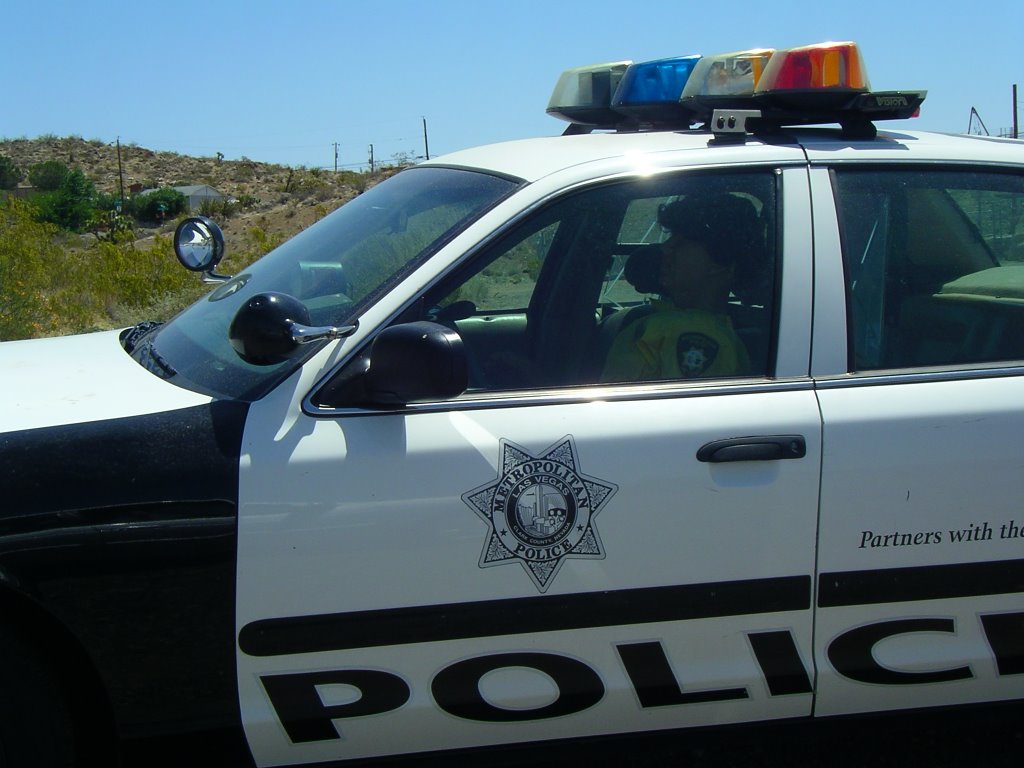
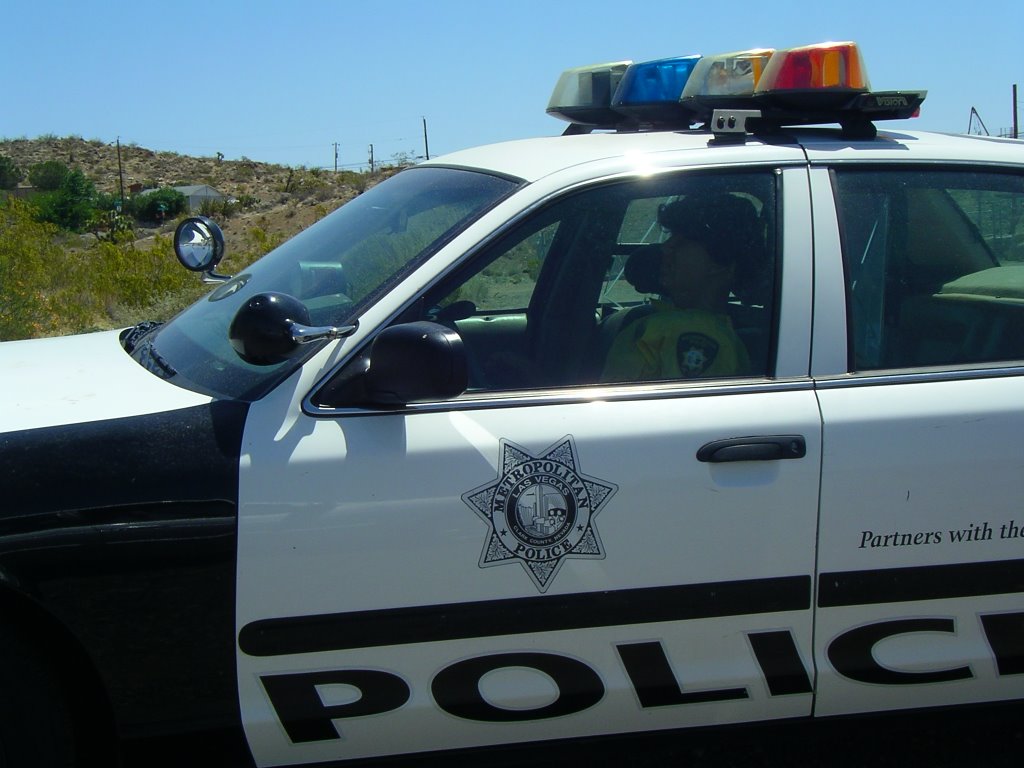 The only time (some) motorists made any attempt to slow down was when they passed this police cruiser parked on the side of the highway. We had little to worry about, as we were well under the posted limit. We still let off the gas and slowed anyway, out of habit. A Lotus grew larger in our rear view mirror before zipping by at 110 mph- right in front the cop. We looked at the cruiser expecting to see reds and blues flashing in fast pursuit. Nothing happened. Something wasn't right. We slowed down even more, and when we pulled alongside the cruiser, we saw the officer was a mannequin. Ha ha ha. The Lotus must have driven by Officer Ken Doll before.
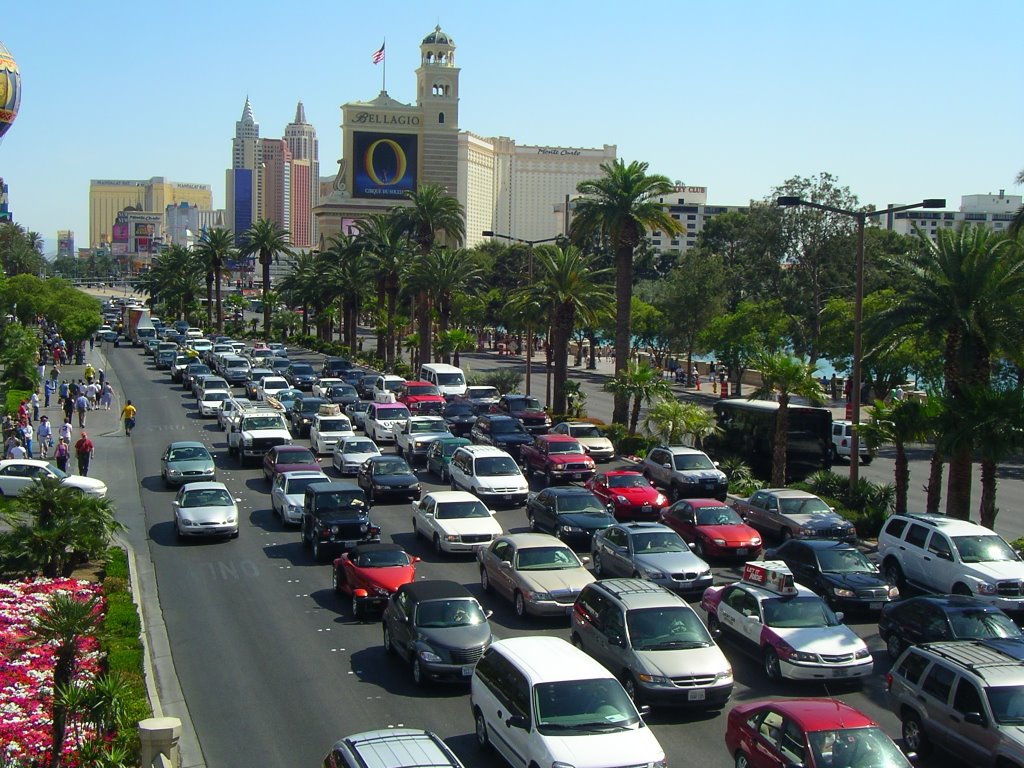 One stretch of road where no one was speeding (much less moving at posted speed), was Las Vegas boulevard, better known as The Strip. Everytime we've been to Vegas, one constant feature is the crowds. It matters not the time of year or time of day. Tens of thousands of people clog the sidewalks and the traffic moves slower than a desert tortoise. For what? $12.99 steak and lobster tail dinners. Free drinks while you play nickel slots. Don Rickles at the Stardust. The town, both smarmy and pretentious at the same time, provides an interesting insight into humanity; billion dollar casinos treat millionaire high rollers to beluga cavair brunches and helicopter tours of the Grand Canyon while penniless bums scavage for cigarette butts in front of the Graceland Drive Thru Wedding Chapel. No where else will you see the extremes of the human existence so oblique. Only in Vegas.
 Everywhere we went, we witnessed more evidence supporting this conclusion. At the Bellagio, the digital billboard advertised the Ansel Adams photography exhibit (lower right), and Rolex watches (lower left). We submit there is no greater value spectrum span than seen here, side by side, (with one unique common trait): Ansel Adams represented a humble existence dedicated to protecting our most sacred natural jewels. Rolex watches are lined with sacred jewels and represent affluence, vanity, and consumerism. Only in Vegas.
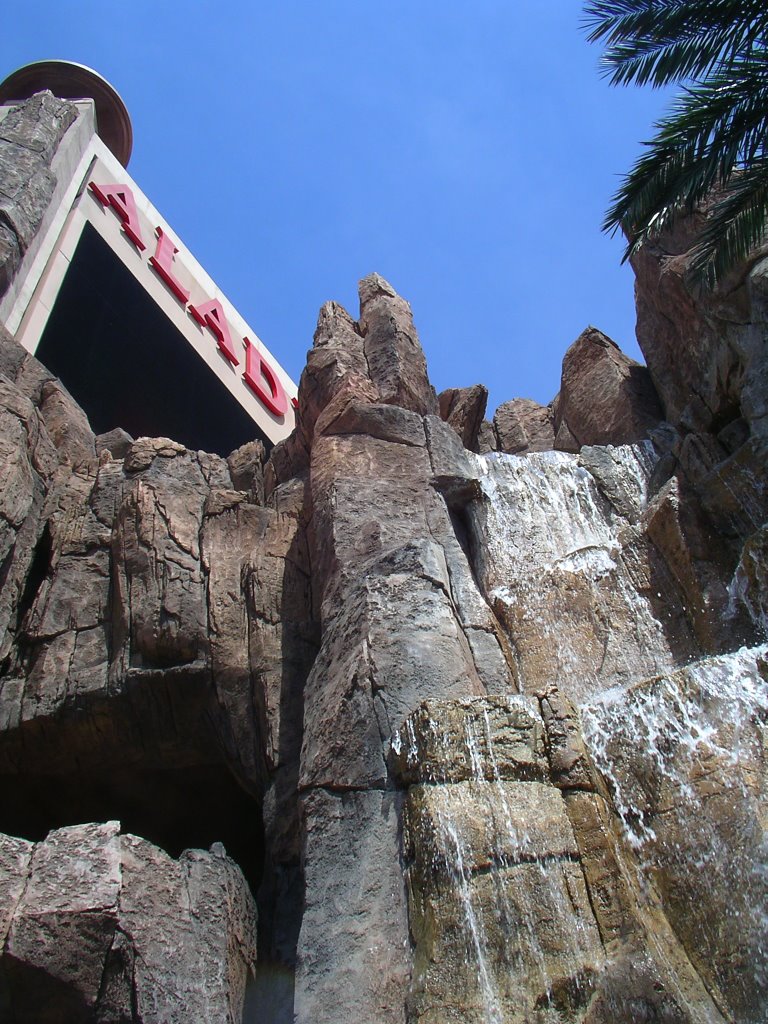 Over at the Aladdin, thousands of gallons of water plummet over a fake waterfall. Not like this is a desert or anything. Not like water evaporates quickly in 100 degree plus temperatures and 7% humidity. Not like in 50 years from now, Vegas and Phoenix (and all the other rapidly growing western cities), will be ghost towns when the aquifier runs dry from all the golf courses, wave parks, and citrus farms. Mark Twain once said, "In the West, water flows uphill. Towards money." Very true. Water can also shoot into the sky towards money, as seen in front of The Bellagio (and choreographed to an Aaron Copland composition). Only in Vegas.
4.16.2006
Tough Guys
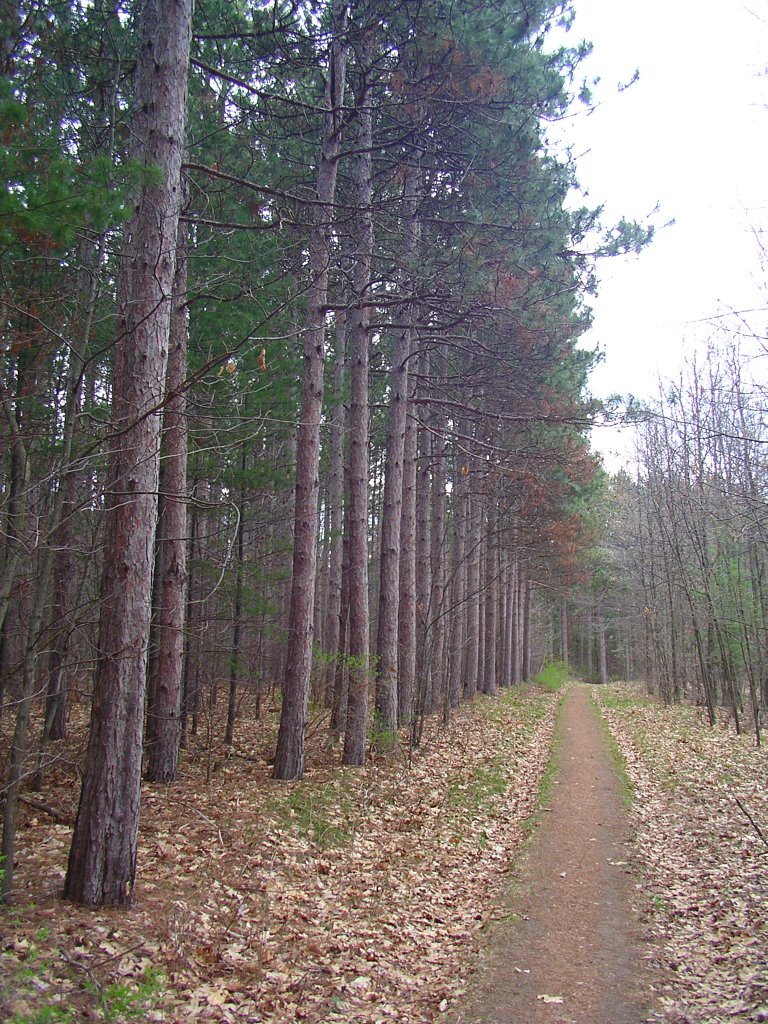 Ah, Springtime. The trees are budding and the wood frogs have awoken from their winter slumber, as evidenced by the cacophony of sound coming out of the low bogs. House wrens and robins announce the arrival of each new day by chirping an hour before the break of dawn. The nearby Peach Mountain woodlands brim with the promise of life and renewal. With the bugs and thorny bushes absent, there's no better time than now to go for a hike.
Peach Mountain is one of our favorite places, for several reasons. While it has an ardent local following, not many people know about it (owned by the University of Michigan and open to the public, it isn't on any maps nor are there any public facilities). Miles of trails pass through mixed successional forests and old-growth pines. Black squirrels and whitetail deer scamper away from the trail as hikers pass. And the birds love the place- just in the last few days, we've seen a Barred owl, a pileated woodpecker, and countless bluejays and cardinals flittering about. One of the other reasons we like the place so much is the trails are in such good shape- for now. When it's time to go for a hike or trail run, this makes a bigger difference than you might think. Good trails (like those pictured here) are even, flat, and free of ruts, rocks, and exposed roots. The likelihood of tripping and twisting an ankle or faceplanting into the dirt is minimal. Unfortunately, it appears this pristine condition is about to change, and for the worse: the sight of tire tracks from mountain bikes is beginning to be more and more common.
 Pictured here (from last summer) is the Potowatami trail at the nearby Pinckney Recreation Area. Notice the contrast in condition: deeply rutted and eroded, with exposed rocks and tree roots jutting out. Why? Because every week, hundreds of mountain bikers tear through the woods, often with reckless abandon and total disrespect for the trails and other trail users. The Potowatami is known throughout the midwest as a premier mountain biking location, and years of use is beginning to take a serious toll on the terra firma.
We have nothing against mountain biking or the many responsible people who partake in it. It's a great way to enjoy the outdoors and get some exercise. But there is a segment of these folks who believe they own the trails with complete entitlement. Time after time, we've seen idiots whiz by people at full speed, trying to brush them off the trail. We've seen countless bikers ignore posted signs requesting they stay off the trails during spring thaw or after a major rain event in an attempt to lessen erosion. And along with all this comes an attitude, as witnessed by the creed of a local mountain biking club.
Let's parse this out, shall we? This is too good to pass up comment!
The Hellriders is an organization born out of frustration with society and The Man that always wants to hold cyclists down. We want nothing more but the freedom to ride our bikes. We will aggressively pursue and defend this freedom, even if it means that we will be called "outlaws".
The Man, huh? Wow. That's a broad indictment. Are you referring to the same Man blamed for perpetuating economic disparity, poverty, the industrial prison system, etc? Aren't you being a little trite here? How about the "freedom to ride our bikes"- where in the constitution is this specified? You "will aggresively pursue and defend this freedom" blah blah blah. How? With an armed militia? "We will be called "outlaws"- so what laws exactly are you operating outside of?
Even in places where cycling is accepted, it is rarely embraced - only tolerated. National, State, and local public land managers "permit" biking on "designated" trails if "proper safety equipment is worn". Although studies have shown cycling can be just as low-impact as foot traffic (walking/hiking/running), pedestrians are not required to jump through similar hoops to access public lands.
It's rarely embraced, huh? What do you want- a cookie? It's only tolerated and permitted? So is everything else that occurs on public land. And for those "studies" that show cycling is just as low-impact as foot traffic...Yeah right! Who conducted those? The same research group that proclaimed smoking was non-carcinogenic?
The Hellriders were not born yesterday, what you see on this website is the culmination of years of pent up frustration born in the backwoods of Hell, Michigan. Hellriders don't seek trouble, just our freedom to ride. However, if that freedom is impinged upon, we won't hesitate to defend it. So, citizens, keep this in mind the next time you throw your fast food bag at one of us out of your car window. Remember these words when you block off our singletrack in order to keep us from riding. You've been warned. Don't give us static. When you trouble trouble, trouble troubles you.
Yikes. We are trembling in our Merrill boots. That bravado must come from all those years working at the bike shop or making lattes at Starbucks. How 'bout this, tough guy- next time you zoom up on someone from their blind side, slow down and give them time to move off to the side. Next time a hard rain falls, let the trails dry before heading out. That's how you'll earn our respect, buddy. And as for Peach Mountain, haven't y'all defiled enough trails?
4.09.2006
Harpers Ferry
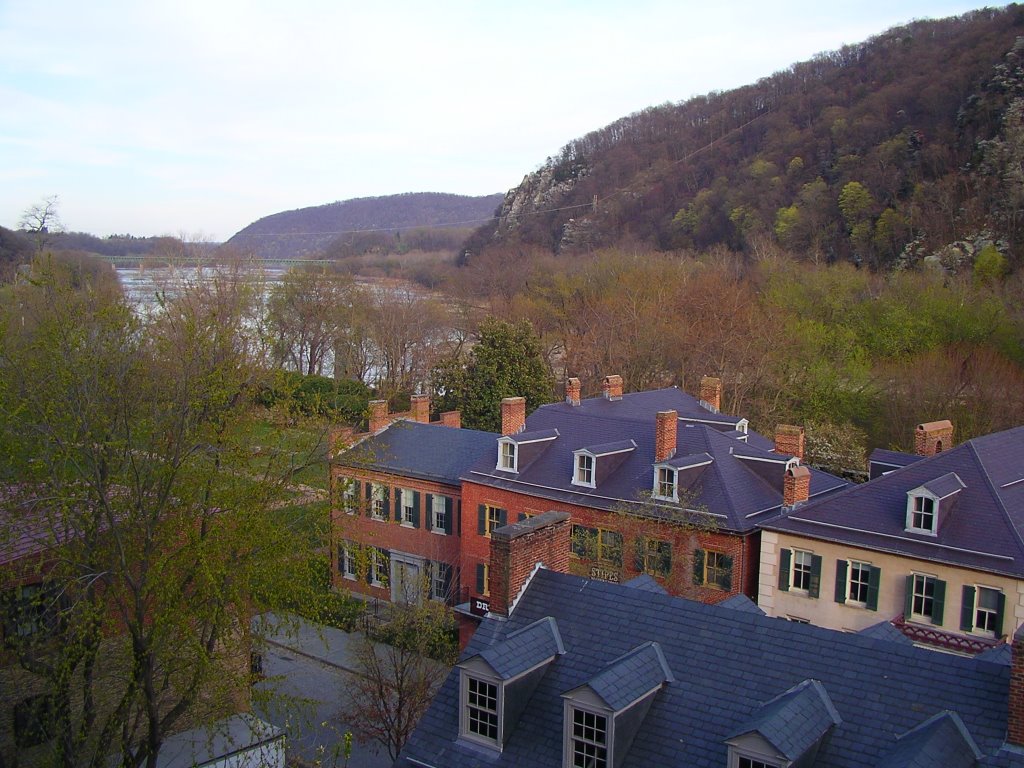 Located at the junction of the Potomoc and Shenandoah rivers in West Virginia, Harpers Ferry is a virtual treasure trove of American history. Most American historical sites focus on a single person or event; at Harpers Ferry, it's the opposite. The list of significant historical occurrences is as broad and diverse and famous as the people who walked down its cobbled streets.
Established in 1794 by President George Washington, Harpers Ferry was created for one purpose: to make guns. His thinking was this: our newly-formed country can not have enough guns. For good reason, too. The British were still pissed about that little Revolutionary War incident, the French were being sneaky in the north, and to the southwest, Mexico was less than excited about having to share the big sandbox. Oh, yeah- one more reason we need lots of guns: the big plan includes overtaking the land from the folks here before us.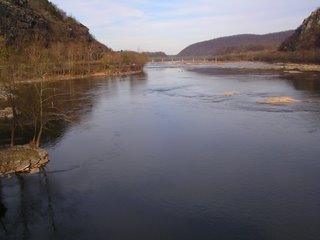 While the armory was busy making guns (over the course of sixty-five years, 600,000 rifles and pistols were made at Harpers Ferry), several notable people came by for a visit. Meriwether Lewis showed up in March of 1803, grabbed a bunch of rifles and tested out his new boat to make sure it floated (it didn't and had to be rebuilt), before heading out on his little trip west. John Brown and some friends came to the arsenal in 1859 and raided the place hoping to leave with 100,000 rifles (so he could arm slaves and start a rebellion). The raid failed and General Robert E. Lee commanded his troops to capture Brown and kill his associates. Brown was hanged for treason a month later and his raid at Harpers Ferry is credited by historians as being one of the sparks that set-off the Civil War. The raid is controversial to this day and illustrates how perception is often the only thing that distinguishes "freedom-fighting" from terrorism.
The town was captured by the Rebs/recaptured by the Feds eight times during the war, and ultimately was reclaimed by the Union after the Battle of Antietam (read the next post down to see how that went) sent the Confederates limping back to Virginny for good. Abraham Lincoln made several visits during the war to meet with generals and inspect the troops. One of the commanding officers present was George Custer, who married his wife at Harpers Ferry (when he wasn't out kicking Johnny Reb in the ass. To this day, Custer is most hated in the South, no doubt because he foiled General Lee's plan at Gettysburg. He isn't much liked out west either. In fact, Michigan is the only place where you'll find any monuments to him). In addition to the historical figures who passed through Harpers Ferry, it's also recognized for implementing industrial advances that forever changed manufacturing. Military inventors designed early methods of automation, such as the water-powered shaft, belt, and clutch system (pictured here) used to run machines that made rifles. As a result of this breakthrough in technology, the time needed to bore a grooved rifle barrel dropped from 150 hours (in the hands of a craftsman) to 30 minutes (in the clamps of a lathe drill). One Army inventor named John Hall came up with the idea of "interchangeable parts" at Harpers Ferry, a concept that was unheard of at the time but ultimately transformed production methods in every form of industry. The military always comes up with cool shit: GPS, nightvision goggles, Jeeps, Hummers, freeze dried food... the list goes on and on.
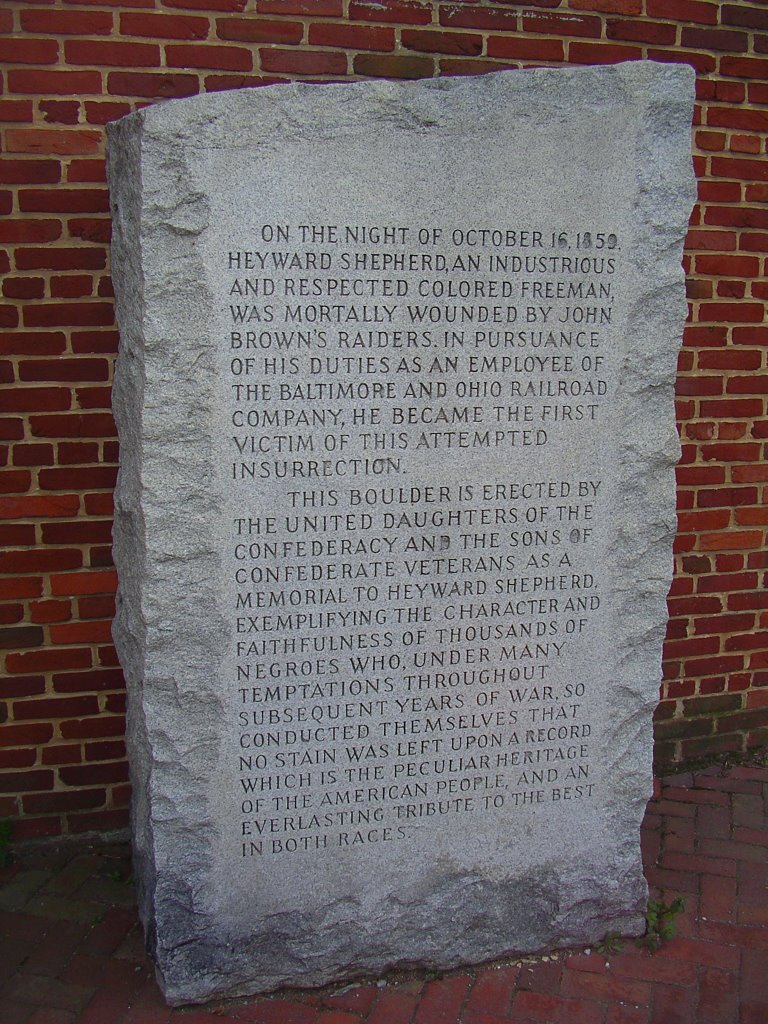 Mixed in with the major historical events and the advancements in technology is a glimpse into how some people view history. This monument, erected by the United Daughters of the Confederacy and Sons of Confederate Veterans, is dedicated to Heyward Shepherd, a black man who worked for the railroad and was killed during John Brown's raid. It reads as follows:
"...as a memorial to Heyward Shepherd, exemplifying the character and faithfulness of thousands of negroes who, under many temptations throughout subsequent years of war, so conducted themselves that no stain was left upon a record which is the peculiar heritage of the American people, and an everlasting tribute to the best in both races."
Some people look back on history through blurred lenses.